Behind the Label: A Vision for Bangladesh’s RMG supply chains
June 1, 2026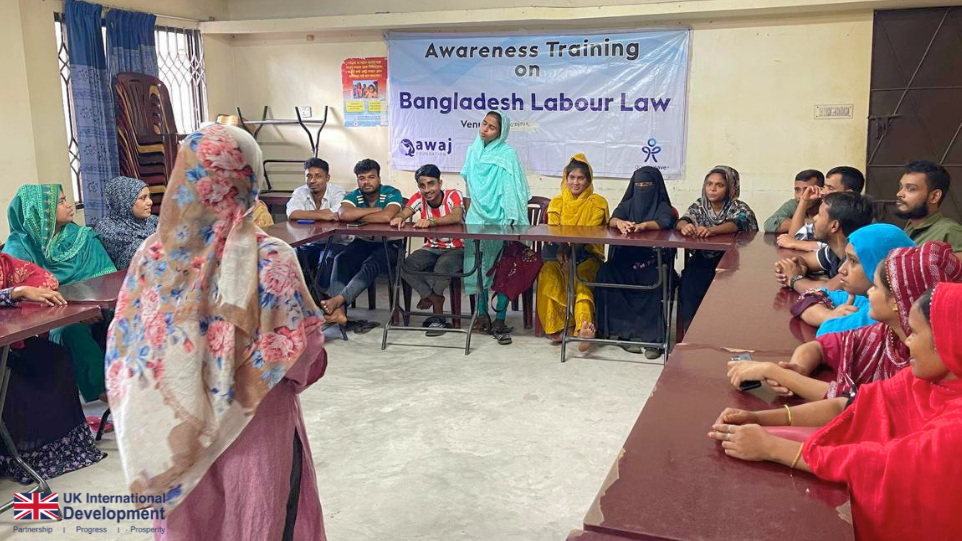
Ms. A. Akter, an employee of an RMG factory in Ashulia, was unlawfully dismissed from work in order to deny her maternity benefits. Unable to resolve the issue at her workplace, Ms. Akter lodged a formal complaint through Awaj Foundation, a local grassroots partner organization of GoodWeave International. Awaj sent an official notice to the factory, seeking an explanation and resolution. After prolonged inaction by the company, Ms. Akter wanted to pursue legal recourse, and Awaj filed a criminal case on her behalf. Through persistent advocacy and negotiation, Awaj successfully facilitated dialogue between Ms. Akter and the factory management, which eventually led to an amicable settlement with the factory management agreeing to pay BDT 50,000 (GBP 315) to Ms. Akter, in recognition of the infringement on her maternity rights and the undue hardship she endured. What Ms. Akter experienced working in the RMG sector in Bangladesh is neither new nor unusual.
Context
While Bangladesh’s readymade garment (RMG) industry has made significant progress in advancing worker rights and working conditions, particularly in occupational health and safety following the collapse of the Rana Plaza in 2013, these improvements have largely remained concentrated in export-oriented Tier 1 factories. Advocates continue to highlight persistent concerns regarding child and forced labor in the lower tiers of the supply chain, where production is frequently subcontracted, and exporters and global brands have less visibility. Through its locally led, worker-centered, and rights-based approach, GoodWeave seeks to strengthen worker protections, safeguard children, and advocate corporate accountability in the hidden tiers of Bangladesh’s apparel supply chain.
Between 2023 and 2026, with funding from the Home Office’s Modern Slavery and Innovation Fund (MSIF) from the U.K Government, GoodWeave International, University of Nottingham’s Rights Lab, and the Bangladesh Labour Foundation (BLF) partnered on the project “Addressing Modern Slavery in the Bangladesh Ready Made Garment (RMG) Sector: Closing the evidence gap and informing solutions.” The initiative aimed to generate evidence of forced and child labor practices within Bangladesh’s ready-made garment (RMG) industry and promote innovative solutions to reduce labor risks across supply chains while increasing awareness and support for vulnerable workers.
Through interviews conducted with nearly 2,000 garment workers in their homes, the project documented the existence of modern slavery such as overtime, unpaid wages, restricted movement, and child labor within Bangladesh’s RMG export sector, particularly in hidden and outsourced production sites.
What our research revealed:
- Child labor remains present in RMG export supply chains in Bangladesh, particularly through subcontracted factories.
- Thirty-two percent of adult RMG workers surveyed were paid below minimum wages.
- One-third of workers reported excessive working hours beyond the legal limit.
- Women earned, on average, 2,000 BDT (18 USD) less per month than their male counterparts.
- Labor risks were more prevalent in subcontracted factories linked to export than in those with direct contracts.
- Fifty-six percent of factory workers surveyed reported experiencing threats or abuse in the workplace.
GoodWeave’s response
As part of the UK-funded initiative and based on over thirty years of experience in India and Nepal, GoodWeave developed an innovative tool based on the 11 ILO Forced Labor Indicators to more effectively identify forced labor risks in the lower tiers of the supply chains where the most vulnerable workers are often employed. With extended support from the U.K. government, GoodWeave continued this work between 2025 and 2026 by advocating for the use of its forced labor assessment tool to improve visibility and accountability into outsourced supply chains. Working in partnership with four U.K based brands (ASOS, Delta Galil, New Look, River Island), GoodWeave tested, refined, and strengthened the rapid forced labor assessment methodology to help brands and suppliers enhance their capacity to protect workers through improved supply chain practices. By enabling the rapid identification of forced labor risks, the tool supports the development of context-specific auditing, prevention and remediation strategies, and the capacity building of suppliers to put in place corrective actions and management systems.
The implementation and expansion of the project also strengthened our meaningful engagement with national stakeholders through advocacy, consultations, and collaborative action planning. The efforts focused on priorities including worker and management capacity building, disseminating child and forced labor risk assessment methodologies, remediation approaches, and the establishment of effective worker grievance mechanisms. This constructive dialogue opened space to influence the national discourse and contribute to positive changes in the RMG sector and in labor policy, extending beyond the immediate scope of the project. At the global level, the project engaged policymakers internationally and private sector partners on strengthening supply chain transparency and accountability in the framework of due diligence legislation.
Through collaboration with our partner organization Awaj Foundation, the project reached 660 workers (78% of them women) across 70 factories through awareness-raising sessions focused on workplace rights and access to remedies, with strong positive evidence of an increase in understanding of their rights among the at-risk workers who attended the training sessions. The initiative also provided worker training on leadership and negotiation skills, and directly supported 300 workers through on-site legal clinics and grievance redress mechanisms, resulting in the recovery of unpaid wages and additional compensation. In addition more than 8,000 workers received information on available grievance mechanisms.
GoodWeave will continue to strengthen its presence and partnership in Bangladesh, building on years of collaboration with local partners to enhance capacity for the prevention and remediation of child and forced labor. By improving supplier management practices and expanding the use of risk identification tools, GoodWeave will deepen engagement with brands, suppliers, and stakeholders across the sector. We will also continue to advocate for national and international policy reforms that align global and local labor standards and deliver meaningful benefits for both workers and businesses.
A Call to Action
GoodWeave has worked closely with the apparel sector in Bangladesh and India for the last decade, collaborating extensively with brands to assess their supply chains, address non-compliance findings, and strengthen human rights due diligence practices, while also training workers on labor rights and supporting them in seeking redress for grievances. Drawing on lessons learned in Bangladesh and India, GoodWeave is entering a new phase of human rights due diligence partnerships, and we invite brands to join us. Our local presence and partnerships, combined with the knowledge we have gained over our 30-year presence in South Asia, position us well to share our expertise by training stakeholders and helping companies build capacity to prevent, assess, and remediate child and forced labor risks.
GoodWeave’s 5-year strategic vision of a system’s change approach for 2030 aligns well with continued progress in Bangladesh’s labor policy. With meaningful national and international policy changes in human rights due diligence on the horizon, collaboration with GoodWeave will amplify the business’ best practices to harness the market power and advocate meaningful changes across the sector. We invite you to join us.